How to Wake Up Early for School: A Student's Guide to Easier Mornings
If you're a student and school mornings feel like a daily battle, you're not imagining it — and it's not just that you "should go to bed earlier". Teenagers' body clocks genuinely shift later during adolescence, so an early school start can land in what your body considers the middle of the night. Here's how to wake up early for school anyway, in a way that actually works for your biology.
The short answer
To wake up early for school: keep the same wake time every day (weekends included, within an hour), get bright light right after waking, move your bedtime earlier in small steps, put your phone away an hour before bed, and use an alarm you can't dismiss half-asleep with snooze turned off. Teens need 8–10 hours of sleep, so bedtime matters as much as the alarm.
Why it's harder for teenagers
During puberty, the body starts releasing melatonin — the "time to sleep" hormone — later in the evening. Many teens naturally don't feel sleepy until around 23:00 or later. Combine that with early school start times, homework, sports, part-time jobs and phones, and many students end up chronically short on sleep.
This is well recognised by experts. The American Academy of Pediatrics has recommended that middle and high schools start no earlier than 8:30am, and California passed a law requiring later start times for most public high schools. Most students, though, still have to work with earlier starts.
How much sleep students need
| Age | Recommended sleep |
|---|---|
| 6–12 years | 9–12 hours |
| 13–18 years | 8–10 hours |
| 18+ (college/university) | 7+ hours |
If you wake at 6:45 for school and need 9 hours, that's asleep by about 21:45. That's hard for most teens — which is why the gradual approach and light exposure below matter so much. More detail: how much sleep do I need?
A school-morning plan that works
1. One wake time, seven days a week
The biggest mistake students make is sleeping until noon on weekends. It feels great, but it shifts your body clock even later, so Sunday night you can't sleep and Monday feels awful. That's called social jet lag. Try to wake within about an hour of your school time on weekends too.
2. Get bright light immediately
As soon as you're up, open the curtains and turn on the brightest lights. If you walk or cycle to school, even better — morning daylight is the strongest signal to shift your body clock earlier. Why dark mornings are extra hard.
3. Move bedtime earlier gradually
If you currently fall asleep at 00:30, jumping to 21:30 won't work — you'll just lie awake. Move 15 minutes earlier every couple of nights. How to fix your sleep schedule has a full plan.
4. Phone away an hour before bed
Phones are the number one reason students sleep later than they intend: group chats, videos, games and scrolling. Charge it away from your bed and pick a "phone down" time. What phones really do to sleep.
OwlRoutine helps you wind down at night and actually get up in the morning — with a guided wind-down, dismiss missions, and sleep scores. Available on iPhone and Android.


5. Set up an alarm that actually works
- Turn snooze off. Every snooze makes you groggier. Here's why.
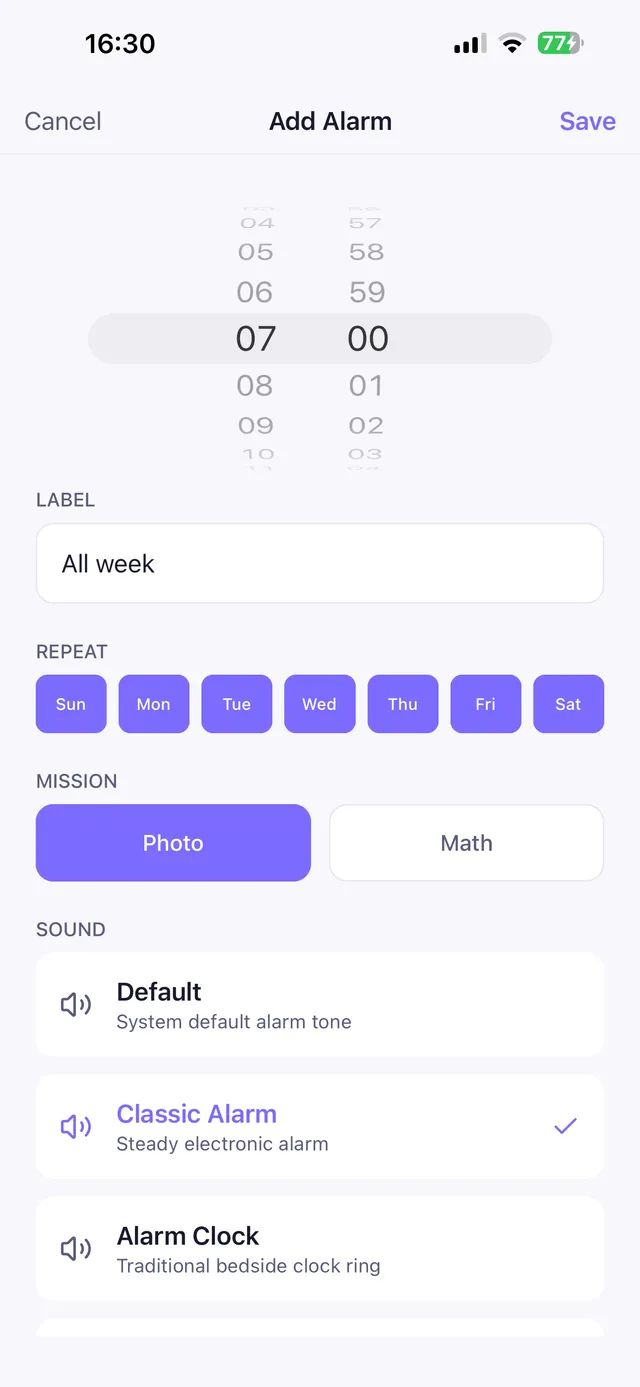
- Use a mission. An alarm that makes you solve a math problem or type a sentence before it stops means you're properly awake. Math alarms explained.
- Put your phone across the room if you tend to turn the alarm off and fall back asleep.
- Check it rings on silent. Test it once with your phone on silent.
6. Prepare the night before
Bag packed, clothes out, breakfast sorted. Fewer decisions in the morning = more time to wake up slowly and less stress.
7. Watch caffeine and energy drinks
Energy drinks and coffee after lunch can keep you awake at night, which makes the next morning worse. Keep caffeine to the morning, if at all.
A sample school-night routine
| Time | What to do |
|---|---|
| 20:30 | Finish homework; pack bag |
| 21:15 | Phone on charge outside the bedroom |
| 21:15–21:45 | Shower, read, stretch or journal |
| 21:45 | Lights out |
| 06:45 | Alarm (no snooze), lights on, water |
Adjust the times to your school start and your sleep need.
For university students
With no bells, later lectures and more freedom, university often means irregular sleep. The same principles apply: a consistent wake time (even on days you don't have a 9am), morning light and a phone-down wind-down. Your future self in exam season will thank you.
When to talk to someone
If you're always exhausted despite trying, fall asleep in class, or can't fall asleep for hours most nights, talk to a parent, school nurse or doctor. Sometimes there's a sleep disorder or another health issue involved, and it's treatable.
The bottom line
Waking up early for school is harder for teenagers because of real biological changes — but it's manageable. Keep a steady wake time every day, get light straight away, move bedtime earlier gradually, put your phone away before bed and use an alarm you can't snooze your way out of.
OwlRoutine is built for exactly this: an alarm that won't stop until you complete a math, word, typing or bed-photo mission, an evening wind-down that checks your phone stays face-down, and streaks and rewards like coins, badges and an avatar shop that make building the habit a bit more fun.
This article is general information, not medical advice.
Frequently asked questions
How can I wake up early for school without being tired?
Get enough sleep (8–10 hours for teens), keep the same wake time every day including weekends, get bright light immediately, put your phone away an hour before bed and turn off snooze.
Why is it so hard for teenagers to wake up early?
During puberty, the body releases melatonin later in the evening, so many teens don't feel sleepy until late. Early school starts then cut sleep short.
What time should a teenager go to bed for school?
Count back 8–10 hours from your wake time. For a 6:45 wake-up, that's roughly 20:45–22:45, depending on individual need.
Is it bad to sleep in on weekends?
A small lie-in is fine, but sleeping several hours later shifts your body clock and makes Monday mornings much harder.
Wake up for real. Wind down for good.
OwlRoutine is a sleep-cycle alarm that makes mornings actually stick — with a guided wind-down, dismiss missions, sleep scores and rewards. Available on iPhone and Android.