Racing Thoughts at Night: Why Your Mind Won't Switch Off and 9 Ways to Quiet It

The lights go out, your body is exhausted — and your brain chooses this exact moment to replay an awkward conversation, plan next week, and worry about something that probably won't happen. Racing thoughts at night are one of the most common reasons people can't fall asleep. They're not a personal failing, and there are well-tested ways to quiet them.
The short answer
Racing thoughts at night happen because bedtime is often the first quiet moment of the day, so unfinished tasks and worries finally get your full attention. To quiet them: schedule "worry time" earlier in the evening, write a to-do list before bed, use a calming mental task like the cognitive shuffle, slow your breathing, and get up if you've been lying awake for about 20 minutes. Long-term, a consistent wind-down routine and CBT for insomnia help most.
Why your mind races at bedtime
- No distractions. All day your attention is taken. In the dark, there's nothing competing with your thoughts.
- Unfinished business. Your brain keeps "open loops" active — tasks and problems it hasn't closed.
- Stress hormones. A stressful day can leave you physiologically alert at night.
- Screens right before bed. Going straight from stimulating content to lights-out leaves your mind still in high gear. What phones do to your sleep.
- Learned association. After many nights of lying awake worrying, bed itself can become a cue for thinking.
9 ways to quiet racing thoughts
| Technique | When to use it | Why it helps |
|---|---|---|
| Worry time | Early evening | Gives worries a slot so they're less urgent at night |
| To-do list | 5 minutes before bed | Offloads open loops |
| Cognitive shuffle | In bed | Replaces worry with random, neutral images |
| Slow breathing | In bed | Calms the body's stress response |
| Body scan | In bed | Moves attention out of your head |
| Get up after 20 minutes | In bed, still awake | Breaks the bed = thinking link |
| Wind-down routine | Every evening | Signals the day is over |
| Limit caffeine and screens | Afternoon and evening | Reduces arousal |
| CBT-I | Ongoing insomnia | First-line treatment with strong evidence |
1. Schedule "worry time"
Set aside 10–15 minutes in the early evening — not right before bed — to write down what's worrying you and, where possible, one next step for each. Researchers have tested a similar "constructive worry" exercise for people with insomnia and found it reduced pre-sleep worry. When a worry pops up at night, remind yourself: "that's for tomorrow's worry time."
2. Write a to-do list before bed
A 2018 study found that people who wrote a specific to-do list for the next few days before bed fell asleep faster than those who wrote about completed tasks. More on journaling before bed.
3. Try the cognitive shuffle
Choose a random word, like "garden". For each letter, imagine as many unrelated objects as you can: g — guitar, goat, glove; a — apple, anchor… The random, neutral images mimic the drifting thoughts of falling asleep and crowd out worry.
4. Slow your breathing
Make your exhale longer than your inhale — for example, in for 4, out for 6–8. This activates your body's calming response. The 4-7-8 technique is one popular version. See more techniques in how to fall asleep fast.
OwlRoutine helps you wind down at night and actually get up in the morning — with a guided wind-down, dismiss missions, and sleep scores. Available on iPhone and Android.


5. Do a body scan
Slowly move your attention from your toes to your head, noticing each area without judgement. It gives your mind a job that isn't thinking. The military sleep method is a structured version.
6. Get up if you're still awake
If you've been awake for about 20 minutes and your thoughts are spiralling, get up. Sit somewhere dim and do something calm and boring until you feel sleepy. It's a core rule of CBT for insomnia and stops your brain linking your bed with lying awake.
7. Build a wind-down routine
A predictable 20–30 minute routine — dim lights, phone away, shower, reading, stretching — tells your brain the day is ending. How to build one.
8. Cut stimulants late in the day
Caffeine in the afternoon and alcohol in the evening both make sleep lighter and more fragmented, which can leave you awake with your thoughts in the middle of the night. The 10-3-2-1-0 rule is a simple guide.
9. Consider CBT for insomnia
If racing thoughts keep you awake most nights for weeks, CBT for insomnia (CBT-I) is the recommended first-line treatment. It combines practical techniques for thoughts and behaviours and is available through therapists and digital programmes.
What not to do
- Don't check the time. Clock-watching fuels "I'll only get 5 hours" panic.
- Don't reach for your phone to distract yourself — it usually adds more to think about.
- Don't try to force sleep. Effort is the enemy. Aim to rest; sleep follows.
When to get help
If racing thoughts come with persistent anxiety, low mood, panic or intrusive thoughts, or they affect your daily life, speak to a doctor or mental health professional. Anxiety and insomnia are both very treatable.
The bottom line
Racing thoughts at night are your brain finally getting airtime for the day's open loops. Give them a slot earlier in the evening, write them down, use a neutral mental task and slow breathing in bed, and get up if sleep isn't coming. A consistent wind-down makes all of it easier.
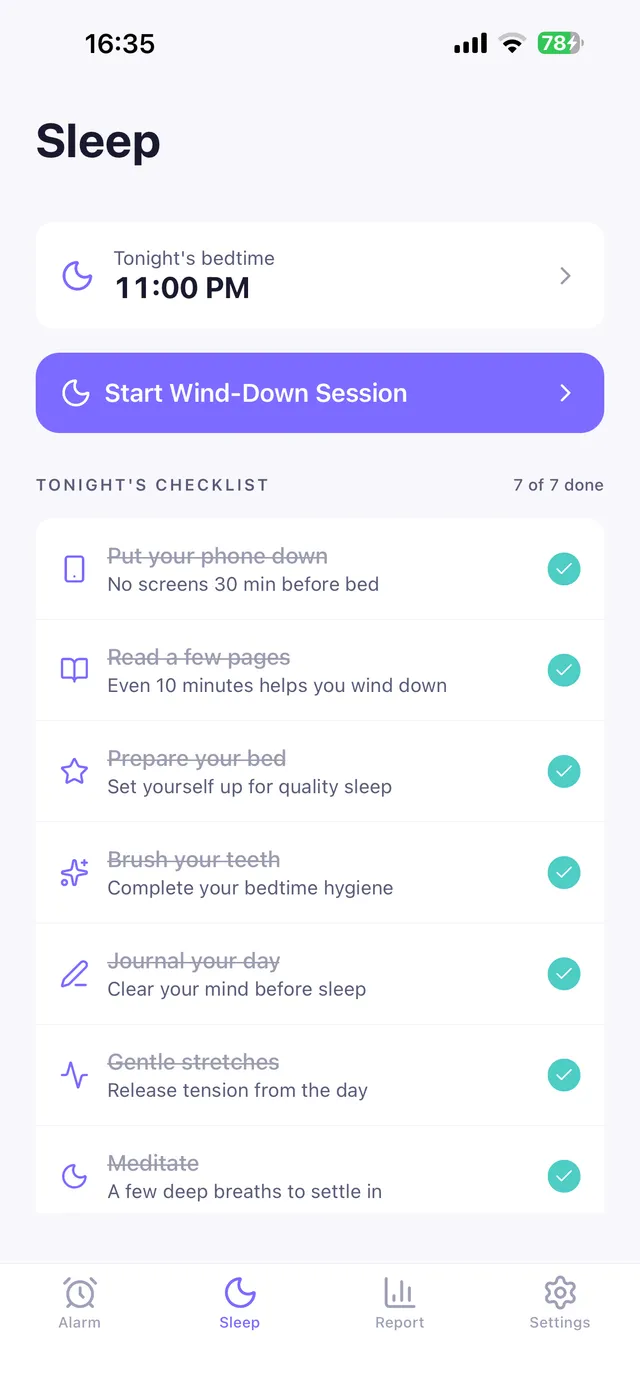
OwlRoutine's guided wind-down session is a ready-made structure for this: a timed, phone-down window with activities like journaling, reading, stretching and meditation, checked by the phone's motion sensor — so the transition from "day brain" to "sleep brain" happens every night, not just when you remember.
This article is general information, not medical advice.
Frequently asked questions
Why does my mind race at night?
Bedtime is often the first quiet moment of the day, so unfinished tasks and worries finally get your attention. Stress, late screens and a habit of lying awake worrying make it worse.
How do I stop overthinking at night?
Schedule worry time earlier in the evening, write a to-do list before bed, use the cognitive shuffle or slow breathing in bed, and get up if you've been awake for about 20 minutes.
What is the cognitive shuffle?
A technique where you pick a random word and, for each letter, imagine unrelated objects that start with that letter. It replaces worry with neutral, random images.
When should I see a doctor about racing thoughts?
If they keep you awake most nights for weeks or come with persistent anxiety, low mood or panic. CBT for insomnia and anxiety treatments are effective.
Wake up for real. Wind down for good.
OwlRoutine is a sleep-cycle alarm that makes mornings actually stick — with a guided wind-down, dismiss missions, sleep scores and rewards. Available on iPhone and Android.