How Much Sleep Do I Need? Recommended Hours by Age (and How to Tell if You're Getting Enough)

"How much sleep do I need?" is one of the most searched health questions there is, and the honest answer has two parts: a well-established range for your age, and a personal amount within that range that you can figure out with a bit of attention. Here are the official guidelines, what affects your personal number, and how to tell whether you're actually getting enough.
The short answer
Most adults need at least 7 hours of sleep per night. Teenagers need 8–10 hours, school-age children 9–12, and younger children and babies more. Regularly getting less than 7 hours as an adult is linked to worse mood, focus and long-term health. Timing and consistency matter too — 7 hours at irregular times isn't the same as 7 hours at a steady time.
Recommended sleep by age
These ranges are used by the US Centers for Disease Control and Prevention (CDC) and are based on guidance from the American Academy of Sleep Medicine and the National Sleep Foundation.
| Age group | Recommended sleep per 24 hours |
|---|---|
| Newborn (0–3 months) | 14–17 hours |
| Infant (4–12 months) | 12–16 hours (including naps) |
| Toddler (1–2 years) | 11–14 hours (including naps) |
| Preschool (3–5 years) | 10–13 hours (including naps) |
| School age (6–12 years) | 9–12 hours |
| Teen (13–18 years) | 8–10 hours |
| Adult (18–60 years) | 7 or more hours |
| Adult (61–64 years) | 7–9 hours |
| Adult (65+ years) | 7–8 hours |
Why "8 hours" isn't the rule for everyone
The "8 hours" rule is a decent shorthand, but individual needs vary. Some adults genuinely feel best on 7, others need closer to 9. A very small number of people carry rare genetic variants that let them function on less, but they're extremely uncommon — if you "need" 5–6 hours, it's far more likely you've adapted to feeling tired than that you're one of them.
Things that raise your sleep need temporarily:
- Illness or recovery from injury.
- Intense training or physical work.
- Previous short nights (sleep debt).
- Pregnancy.
- Periods of high stress or learning.
Is 6 hours of sleep enough?
For most adults, no. In a well-known 2003 study from the University of Pennsylvania, people restricted to six hours a night for two weeks showed steadily worsening attention — eventually comparable to people who'd gone a night or two without sleep — while rating themselves only slightly sleepy. That's the trap: you adapt to feeling tired, but your performance doesn't adapt.
OwlRoutine helps you wind down at night and actually get up in the morning — with a guided wind-down, dismiss missions, and sleep scores. Available on iPhone and Android.


Quantity isn't the whole story
Two nights of 7.5 hours can feel completely different depending on:
- Consistency. Going to bed and waking at similar times makes the same hours more restorative. Sleep consistency matters more than you'd think.
- Timing. Waking mid-cycle can leave you groggy even after a long night — sleep inertia explains why.
- Quality. Alcohol, noise, a warm room or untreated sleep apnea fragment sleep, so you get less real rest from the same hours. Why you wake up tired after 8 hours covers the common culprits.
How to find your personal sleep need
Try this on a holiday or low-pressure week:
- Pick a consistent bedtime that's realistic for you.
- Don't set an alarm (or set it late as a safety net) and wake naturally.
- After the first few days, once any sleep debt is repaid, note how long you sleep on average.
- Check how you feel: alert through the morning, no heavy afternoon slump, not reliant on caffeine to function.
That average is a good estimate of your need. Then set your alarm and bedtime to protect it.
Signs you're not getting enough sleep
- You need an alarm and still feel terrible when it rings — and you sleep through it regularly.
- You sleep much longer on weekends than weekdays.
- You fall asleep within minutes of lying down, almost every time.
- You rely on caffeine to get through the morning and again in the afternoon.
- You're more irritable, forgetful or snacky than usual.
- You nod off in meetings, on public transport or while watching TV.
How to get more sleep without more time in bed
- Protect a consistent wake time, then move bedtime earlier. How to fix your sleep schedule has a step-by-step plan.
- Cut late caffeine and alcohol.
- Build a short wind-down so you actually fall asleep when you get into bed. Here's a simple routine.
- Keep phones out of bed to avoid revenge bedtime procrastination.
The bottom line
Adults need at least 7 hours, teens 8–10, and kids more. Within that, your personal number is the amount that lets you wake without a fight and stay alert all day — and you'll only get it consistently if you protect both bedtime and wake time.
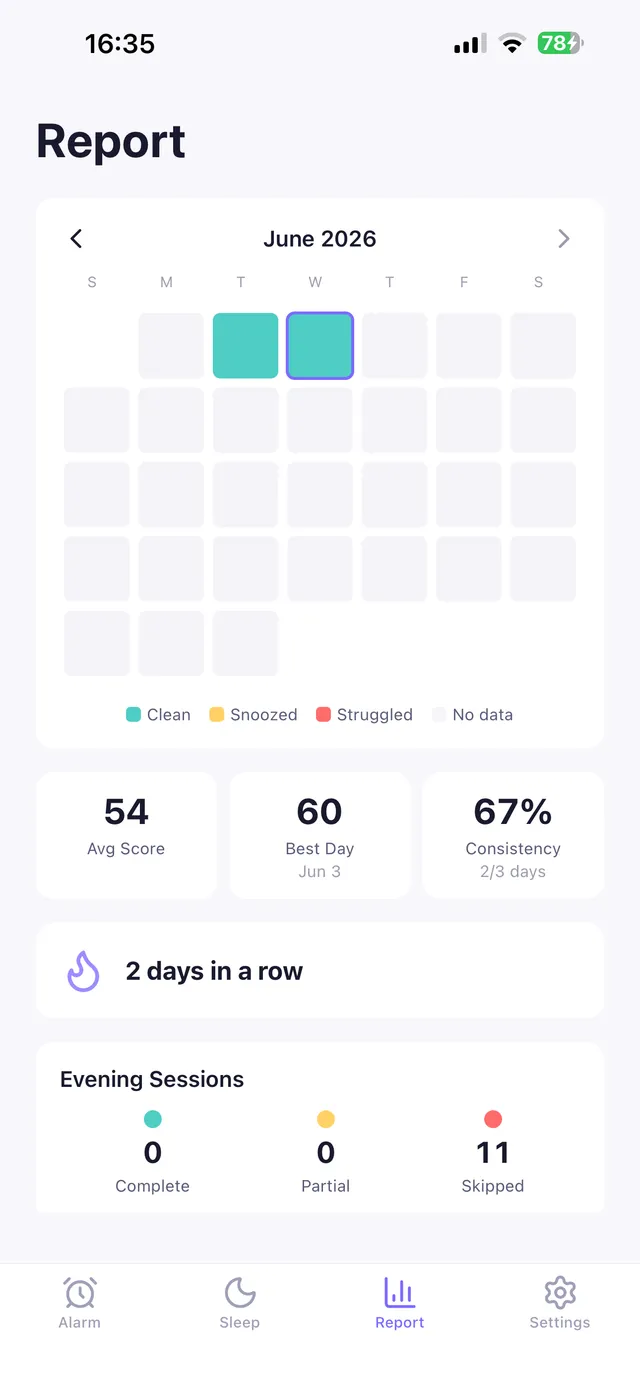
OwlRoutine helps with both sides: bedtime reminders and a guided wind-down to get you to bed on time, a consistent mission alarm to anchor your wake time, and a report with streaks, weekly charts and a heatmap so you can see whether you're actually getting the sleep you need.
This article is general information, not medical advice. If you feel exhausted despite getting enough sleep, talk to a doctor.
Frequently asked questions
How much sleep does an adult need?
Most adults need at least 7 hours of sleep per night. Needs vary between individuals, and some feel best closer to 8–9 hours.
Is 6 hours of sleep enough?
For most adults, no. Research shows that repeated six-hour nights cause steadily worsening attention and performance, even though people often feel only slightly sleepy.
How much sleep do teenagers need?
Teenagers aged 13–18 need 8–10 hours of sleep per night.
Can I catch up on sleep at the weekend?
A little extra sleep can help repay short-term debt, but big weekend lie-ins shift your body clock and make Monday mornings harder. Consistent sleep through the week is better.
Wake up for real. Wind down for good.
OwlRoutine is a sleep-cycle alarm that makes mornings actually stick — with a guided wind-down, dismiss missions, sleep scores and rewards. Available on iPhone and Android.