Social Jet Lag: Why Weekend Lie-Ins Make Mondays So Hard (and How to Fix It)

You haven't been on a plane, but every Monday morning feels like you've just flown across a few time zones. That's social jet lag: the gap between when your body wants to sleep and when your work or school schedule makes you sleep. The most common cause is simple — sleeping late on weekends and early on weekdays.
The short answer
Social jet lag is the difference between the midpoint of your sleep on free days and the midpoint on work days. If you sleep 23:30–07:00 on weekdays and 01:30–10:30 on weekends, your body experiences a two-hour-plus time zone shift every week. To reduce it, keep your weekend wake time within about an hour of your weekday time and get morning light on weekends too.
Where the term comes from
"Social jet lag" was coined by chronobiologist Till Roenneberg and colleagues in the mid-2000s. Using the Munich Chronotype Questionnaire, they found that a large share of people shift their sleep substantially between work days and free days — and that this weekly shift behaves a lot like travelling across time zones.
How to calculate your social jet lag
- Work days: find the midpoint of your sleep. Asleep 23:30, awake 07:00 → midpoint 03:15.
- Free days: find the midpoint. Asleep 01:30, awake 10:30 → midpoint 06:00.
- Subtract: 06:00 − 03:15 = 2 hours 45 minutes of social jet lag.
| Social jet lag | What it feels like |
|---|---|
| Under 1 hour | Minimal; normal variation |
| 1–2 hours | Noticeably rough Mondays |
| 2+ hours | Like flying across several time zones every weekend |
Why social jet lag matters
- Monday mornings feel brutal because your body clock thinks it's much earlier than it is.
- Sunday nights are hard — you're not sleepy at your weekday bedtime, so you start the week short on sleep.
- It feeds sleep debt. Short weeknights → long weekend lie-ins → late Sunday → short Monday. How sleep debt adds up.
- Research links larger social jet lag to worse mood and metabolic health markers in observational studies. These are associations, not proof of cause, but they're consistent enough to take seriously.
Evening types (night owls) usually have the most social jet lag, because weekday schedules pull them furthest from their natural rhythm. Chronotypes explained.
OwlRoutine helps you wind down at night and actually get up in the morning — with a guided wind-down, dismiss missions, and sleep scores. Available on iPhone and Android.


How to reduce social jet lag (without cancelling your weekends)
1. Cap the weekend lie-in
Aim to wake within about an hour of your weekday time. If you wake at 07:00 on weekdays, 08:00 on Saturday still feels like a treat once you're used to it.
2. Get weekend morning light
Even if you do sleep in a bit, get outside or next to a bright window soon after waking. Light anchors your body clock and limits the drift.
3. Go to bed earlier during the week
Big weekend lie-ins are often your body collecting on weekday sleep debt. Adding 30 minutes to weekday nights reduces the urge to crash on Saturday. How much sleep do you need?
4. Handle late nights differently
After a late Saturday night, get up close to your usual time and take a short early-afternoon nap (10–20 minutes) if needed, rather than sleeping until noon. Then go to bed a little earlier on Sunday.
5. Make Sunday evening a wind-down
Sunday night sets up Monday. Dim the lights, put the phone away and follow your wind-down routine at your weekday bedtime.
6. Use the same alarm every day
A single alarm at the same time seven days a week is the simplest tool for social jet lag. If Saturday mornings are where your willpower breaks, make the alarm do the work: a short mission that gets you up, and no snooze. How to fix your sleep schedule has a full reset plan.
Who gets the worst social jet lag?
- Teenagers and students, whose body clocks naturally run late while school starts early.
- Night owls on standard 9-to-5 schedules.
- Parents of young children, whose weekday and weekend routines differ.
- People with busy social weekends, where late Friday and Saturday nights are the norm.
If you're in one of these groups, small, consistent changes — especially weekend morning light and a capped lie-in — matter even more.
What about "catching up"?
A little extra sleep on the weekend is better than none if you're short on sleep. But research suggests weekend recovery sleep doesn't fully reverse the effects of weekday restriction, and it shifts your rhythm. The best fix is fewer short nights, not longer lie-ins.
The bottom line
Social jet lag is your body clock being dragged across time zones every weekend. Measure it with the sleep-midpoint method, keep weekend wake-ups within an hour of weekdays, get weekend morning light and protect Sunday night. Mondays get dramatically easier.
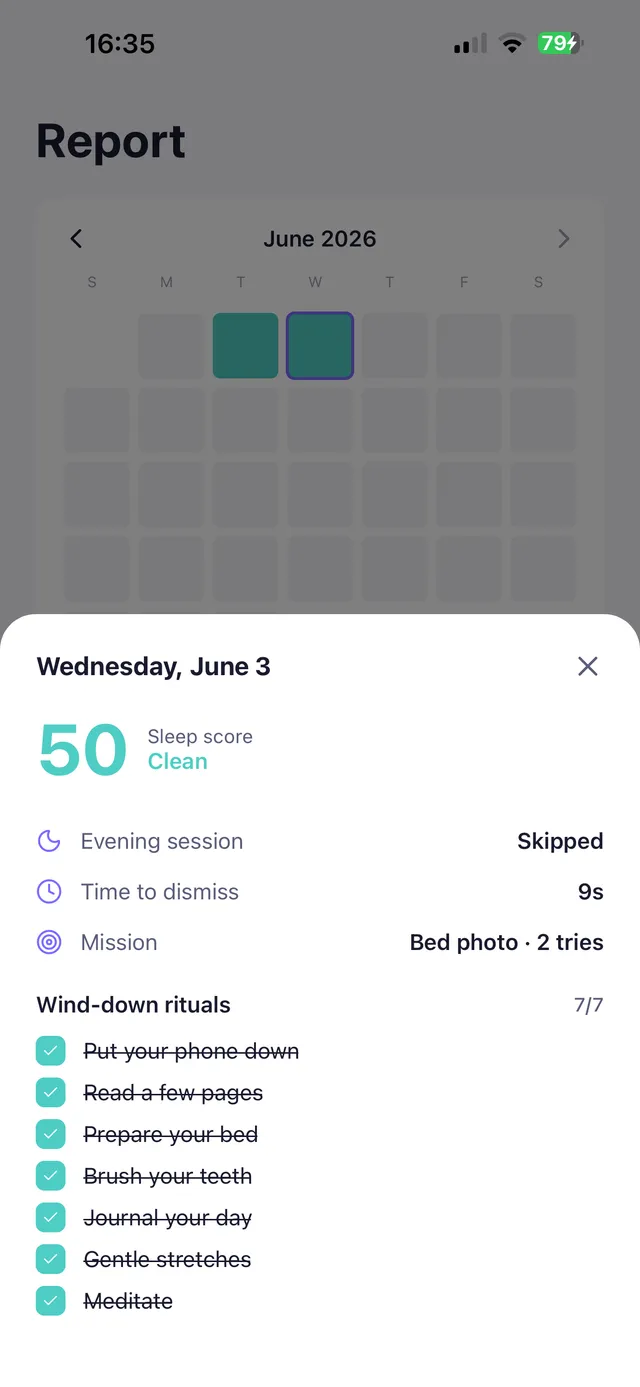
OwlRoutine helps by making consistency the default: repeating alarms for every day of the week with a mission to dismiss, bedtime reminders and a guided wind-down, and a monthly heatmap that makes weekend drift visible at a glance.
This article is general information, not medical advice.
Frequently asked questions
What is social jet lag?
Social jet lag is the mismatch between your body clock and your social schedule, usually measured as the difference between your sleep midpoint on free days and on work days.
How do I calculate social jet lag?
Find the midpoint of your sleep on work days and on free days, then subtract. For example, a work-day midpoint of 03:15 and a free-day midpoint of 06:00 means 2 hours 45 minutes of social jet lag.
Is sleeping in on weekends bad?
A small lie-in is fine, but sleeping in by two hours or more shifts your body clock later and makes Sunday nights and Monday mornings harder.
How do I fix social jet lag?
Keep your weekend wake time within about an hour of weekdays, get morning light on weekends, sleep enough during the week and protect your Sunday night wind-down.
Wake up for real. Wind down for good.
OwlRoutine is a sleep-cycle alarm that makes mornings actually stick — with a guided wind-down, dismiss missions, sleep scores and rewards. Available on iPhone and Android.