How to Stop Oversleeping: Why It Happens and 9 Ways to Get Up on Time

You meant to be up at 7. It's 9:40, you've missed your workout, and you're already behind. If oversleeping is becoming a pattern, it's worth treating it like a solvable problem rather than a character flaw. Here's how to stop oversleeping — starting with why it happens in the first place.
The short answer
Most people oversleep because they're short on sleep during the week, their schedule has drifted later, or they switch off the alarm without fully waking. To stop oversleeping: get enough sleep, fix your wake time seven days a week, use an alarm that requires real effort to dismiss, and get bright light immediately. If you sleep 9+ hours regularly and still feel tired, talk to a doctor.
What counts as oversleeping?
There are two different problems that people call "oversleeping":
- Sleeping past your alarm or intended wake time — the most common, and mostly a habit and schedule issue.
- Regularly sleeping far longer than you need (often 9–10+ hours for adults) and still feeling unrefreshed — which can point to an underlying health issue.
This article focuses on the first, with a section on when the second needs medical attention.
Why you oversleep
| Cause | What it looks like | Fix |
|---|---|---|
| Sleep debt | Crash-sleeping on weekends or after busy weeks | More consistent sleep through the week |
| Drifted schedule | Can't fall asleep before 1am, can't wake before 9 | Wake-time-first reset |
| Autopilot dismissal | No memory of turning the alarm off | Mission alarm |
| Snooze habit | 5+ snoozes, then oversleep | Disable snooze |
| Dark mornings | Worse in autumn and winter | Bright light after waking |
| Alcohol or late nights | Oversleep after nights out | Earlier cutoff, protect wake time |
| Health issue | Long sleep, still exhausted | See a doctor |
9 ways to stop oversleeping
1. Pay off your sleep debt
The body will take the sleep it's owed. If you get 5.5 hours on weeknights, oversleeping on Saturday is your brain collecting the debt. The long-term fix is simply getting closer to your real need every night — most adults need at least 7 hours.
2. Fix your wake time — including weekends
A consistent wake time is the anchor of your body clock. If you wake at 7 on weekdays and 11 on weekends, every Monday feels like jet lag. Keep your wake time within about an hour, seven days a week. How to fix your sleep schedule has a two-week plan.
3. Make the alarm impossible to dismiss on autopilot
Many oversleepers don't sleep through the alarm — they turn it off without being conscious enough to remember. A mission (a math problem, typing a phrase, photographing a specific spot) needs enough thinking that you're genuinely awake by the time it stops. More on this in why you sleep through your alarm.
4. Turn off snooze
Snoozing turns one alarm into a series of short, useless naps and restarts grogginess each time. And the more you snooze, the more likely you'll eventually silence the final alarm and roll over. Why snoozing makes you more tired.
OwlRoutine helps you wind down at night and actually get up in the morning — with a guided wind-down, dismiss missions, and sleep scores. Available on iPhone and Android.


5. Get light immediately
Open the curtains, turn on bright lights or step outside. Light suppresses melatonin and raises alertness. If mornings are dark, a bright lamp near your bed is a reasonable substitute.
6. Move within the first two minutes
Sit up, feet on the floor, stand. Make the bed, drink water, walk to the kitchen. The goal is to exit the "just five more minutes" zone before your brain starts negotiating.
7. Protect the night before
Oversleeping often starts at midnight. Late screens, late caffeine, alcohol and revenge bedtime procrastination all push your sleep later and make the morning harder. The 10-3-2-1-0 rule is a simple framework.
8. Give yourself a reason to get up
"I should get up" is weaker at 7am than "I'll lose my streak" or "I'm meeting a friend at 7:30". Small commitments, a visible streak or a morning activity you look forward to make getting up less abstract.
9. Use a backup alarm for important days
For flights, exams and interviews, set a second alarm on another device. Make sure your main alarm rings on silent — iPhone alarm not going off? has a checklist.
When oversleeping is a health issue
Talk to a doctor if:
- You regularly sleep 9–10+ hours and still feel exhausted.
- You have loud snoring, gasping or pauses in breathing at night.
- You feel very sleepy during the day, including falling asleep at inappropriate times.
- Oversleeping comes with low mood, loss of interest or changes in appetite.
Sleep apnea, depression, hypothyroidism, narcolepsy, idiopathic hypersomnia and some medications can all cause excessive sleep or sleepiness. These are treatable, and no alarm strategy will fix them on its own.
The bottom line
Oversleeping usually comes from sleep debt, a drifted schedule or an alarm you can silence on autopilot. Sleep enough, hold your wake time every day, make the alarm require real thought, skip snooze and get light and movement straight away. If you're sleeping long and still exhausted, see a doctor.
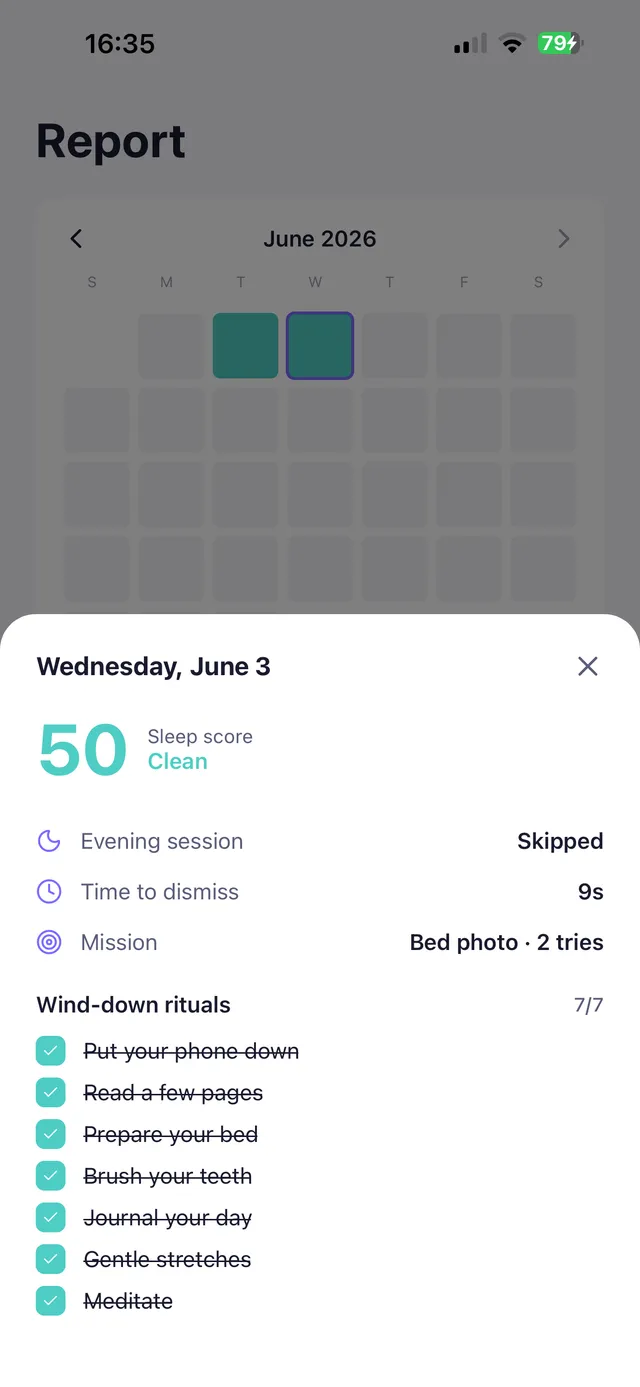
OwlRoutine combines several of these fixes: mission alarms that don't stop until you solve them, snooze you can switch off, a guided wind-down to protect the night before, and a heatmap that shows which days you're oversleeping so you can spot the pattern.
This article is general information, not medical advice.
Frequently asked questions
Why do I keep oversleeping?
Common causes are sleep debt during the week, a sleep schedule that has drifted later, switching off the alarm without fully waking, snoozing, dark mornings and late nights or alcohol.
How do I stop oversleeping on weekends?
Keep your wake time within about an hour of your weekday time, and get enough sleep during the week so there's less debt to catch up on.
Is oversleeping bad for you?
Occasional lie-ins are fine. Regularly sleeping 9–10+ hours and still feeling tired can signal sleep debt or an underlying condition, so talk to a doctor if it persists.
What is the best alarm to stop oversleeping?
One that requires a mission to dismiss — such as solving a math problem or taking a photo — combined with snooze turned off and a consistent wake time.
Wake up for real. Wind down for good.
OwlRoutine is a sleep-cycle alarm that makes mornings actually stick — with a guided wind-down, dismiss missions, sleep scores and rewards. Available on iPhone and Android.