Bedtime Calculator: What Time Should I Go to Bed to Wake Up Refreshed?

"What time should I go to bed?" sounds like it should have a simple answer — and with a bedtime calculator, it mostly does. Sleep runs in cycles of roughly 90 minutes, and waking at the end of a cycle, in light sleep, tends to feel far easier than being dragged out of deep sleep. Below is a ready-made table for common wake-up times, how to calculate your own, and the caveats that sleep calculator websites usually leave out.
The short answer
To use a bedtime calculator, count back from your wake time in 90-minute sleep cycles and add about 15 minutes to fall asleep. For most adults, aim for 5 cycles (7.5 hours) or 6 cycles (9 hours) of sleep. For a 7:00 wake-up, that means lights out around 23:15 (5 cycles) or 21:45 (6 cycles).
Bedtime calculator table
These bedtimes assume ~15 minutes to fall asleep and 90-minute cycles.
| Wake-up time | 6 cycles (9 h) | 5 cycles (7.5 h) | 4 cycles (6 h) — not ideal |
|---|---|---|---|
| 05:00 | 19:45 | 21:15 | 22:45 |
| 05:30 | 20:15 | 21:45 | 23:15 |
| 06:00 | 20:45 | 22:15 | 23:45 |
| 06:30 | 21:15 | 22:45 | 00:15 |
| 07:00 | 21:45 | 23:15 | 00:45 |
| 07:30 | 22:15 | 23:45 | 01:15 |
| 08:00 | 22:45 | 00:15 | 01:45 |
| 08:30 | 23:15 | 00:45 | 02:15 |
| 09:00 | 23:45 | 01:15 | 02:45 |
Four cycles (six hours) is included because people search for it, but for most adults it's not enough on a regular basis — see how much sleep you actually need.
How to calculate your own bedtime
- Start with your wake-up time. For example, 06:45.
- Subtract 90 minutes per cycle. Five cycles = 7 h 30 min → 23:15.
- Subtract your usual time to fall asleep. If it takes you about 15 minutes → 23:00.
- Start your wind-down 30 minutes earlier → begin winding down at 22:30.
If you usually fall asleep faster or slower, adjust step 3. If you often take more than 30 minutes, fixing that matters more than any calculator — see the military sleep method and the 10-3-2-1-0 rule.
Why 90-minute cycles help (and where they don't)
Each night you move through several cycles of light sleep, deep sleep and REM. Deep sleep dominates the early cycles; REM gets longer later in the night. Waking at the end of a cycle usually means waking from lighter sleep, which reduces sleep inertia — the groggy, heavy feeling after an alarm. Sleep cycles explained covers the stages in detail.
But there are important caveats:
- Cycles aren't exactly 90 minutes. They vary from about 70 to 120 minutes between people and across the night.
- Your time to fall asleep varies from night to night.
- You wake briefly between cycles anyway, often without remembering.
So a calculator gives you a sensible target, not a precise timestamp. Think of it as "aim for about 7.5 or 9 hours, not 8 hours and 10 minutes."
OwlRoutine helps you wind down at night and actually get up in the morning — with a guided wind-down, dismiss missions, and sleep scores. Available on iPhone and Android.


What matters more than the calculator
A consistent schedule
The single best way to wake at the right point in your sleep is to go to bed and wake up at the same times every day. Your body learns the pattern and starts shifting into lighter sleep before your alarm. Sleep consistency matters more than sleep length.
Actually falling asleep at bedtime
A calculated bedtime is useless if you get into bed at 23:00 and scroll until 00:30. A 20–30 minute wind-down routine and a phone-down rule are what turn a bedtime into sleep.
Enough total sleep
If you're chronically short on sleep, even perfect cycle timing won't make mornings easy — sleep debt makes deep sleep heavier and waking harder. Here's how to fix your sleep schedule.
Common questions people use a bedtime calculator for
- "I need to wake up at 6. When should I sleep?" Around 22:15 for 7.5 hours, or 20:45 for 9.
- "I have to be up at 7:30 for school." Around 23:45 for 7.5 hours; teens ideally need more, so earlier is better.
- "It's 1am and I need to be up at 7." Right now, you'd get about 4 cycles if you fall asleep quickly. Get into bed now, skip the snooze in the morning, and get bright light immediately.
The bottom line
A bedtime calculator is a handy starting point: count back 90-minute cycles from your wake-up time, add about 15 minutes to fall asleep, and aim for 5–6 cycles. But consistency, a real wind-down and enough total sleep matter more than hitting the exact minute.
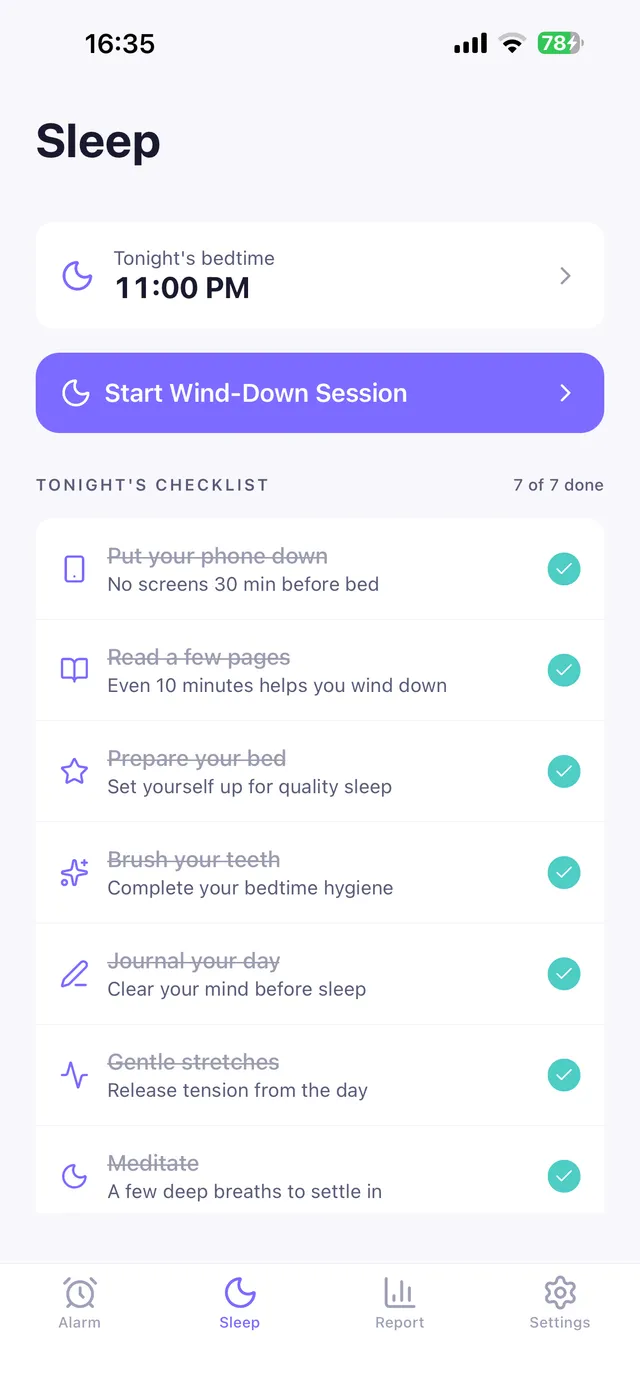
OwlRoutine helps you turn the calculated bedtime into a habit: bedtime reminders tell you when to start winding down, the guided wind-down session keeps the phone face-down, and a consistent mission alarm anchors the other end of the night.
Frequently asked questions
What time should I go to bed to wake up at 7am?
For 5 sleep cycles (7.5 hours) plus about 15 minutes to fall asleep, go to bed around 23:15. For 6 cycles (9 hours), around 21:45.
How does a sleep cycle calculator work?
It counts back from your wake-up time in roughly 90-minute sleep cycles and adds time to fall asleep, so your alarm is more likely to go off in lighter sleep.
Are sleep cycles always 90 minutes?
No. They average about 90 minutes but range from roughly 70 to 120 minutes and vary through the night, so calculator times are estimates.
Is 6 hours of sleep (4 cycles) enough?
For most adults, not regularly. Adults need at least 7 hours, so aim for 5 or 6 cycles.
Wake up for real. Wind down for good.
OwlRoutine is a sleep-cycle alarm that makes mornings actually stick — with a guided wind-down, dismiss missions, sleep scores and rewards. Available on iPhone and Android.