How Many Sleep Cycles Per Night Do You Actually Need?

If you've ever woken up after 8 hours feeling worse than after 6, the culprit is often where your alarm landed inside a sleep cycle, not just how many hours you got. Here's the quick numeric answer to how many cycles you actually need per night, and how to use that number.
The short answer
Most adults cycle through sleep in roughly 90-minute blocks, so a full night usually means 5 to 6 sleep cycles (about 7.5 to 9 hours). Fewer than 4-5 cycles (under 6-7.5 hours) tends to leave you noticeably under-rested. The goal isn't just hitting a number of hours — it's waking up at the end of a cycle, in lighter sleep, rather than mid-cycle in deep sleep.
How many cycles, by hours of sleep
| Time in bed | Approx. cycles | How it typically feels |
|---|---|---|
| 4.5 hours | 3 | Functional in a pinch, not restorative |
| 6 hours | 4 | Under-slept for most adults |
| 7.5 hours | 5 | Solid, commonly recommended minimum |
| 9 hours | 6 | Full night for many adults |
| 10.5 hours | 7 | Long sleepers, teens, recovery from debt |
These numbers assume the textbook 90-minute average — in reality cycles run anywhere from about 70 to 120 minutes and shift across the night, so treat this table as a planning tool, not a guarantee. For the full biology of what happens in each cycle (light sleep, deep sleep, REM), see sleep cycles explained.
Why the cycle count matters more than the hour count
Two people can both sleep "7 hours" and feel completely different in the morning, because one woke up at the end of a cycle (light sleep, easy to rouse) and the other got yanked out mid-cycle (deep sleep, disorienting). That grogginess has a name — sleep inertia — and it's worse the deeper into a cycle your alarm catches you.
This is why "I got 8 hours and still feel awful" is such a common complaint. It's usually not the hour count that's wrong — see why you wake up tired after 8 hours for more on that pattern. It's the timing.
OwlRoutine helps you wind down at night and actually get up in the morning — with a guided wind-down, dismiss missions, and sleep scores. Available on iPhone and Android.


So how many cycles do YOU need?
There's no single universal number — it depends on age, individual sleep need, and recent sleep debt. As a starting point:
- Most adults: 5-6 cycles (7.5-9 hours) covers the commonly recommended range.
- Teens: often need closer to 6 cycles (9 hours) — their biology genuinely requires more.
- Older adults: sometimes function on 4.5-5 cycles, though quality matters more than at younger ages.
- After a bad stretch of sleep: your body may push for 6+ cycles for a few nights to repay debt — that's normal, not a sign something's wrong.
The only reliable way to know your personal number is to track how you feel across a week or two at different total sleep times and notice where you consistently wake up clear-headed without an alarm.
Timing your night around whole cycles
Because 90 minutes is only an average, cycle-based alarm timing is a useful estimate, not an exact science — but it beats picking a wake time at random. The practical version:
- Pick a wake time you need to hit.
- Count backwards in 90-minute blocks to find bedtimes that land you at the end of a cycle (e.g., for a 6:30am wake-up: roughly 9pm, 10:30pm, or midnight to bed).
- Add 10-20 minutes to account for the time it typically takes to fall asleep.
- Aim for 5-6 full cycles most nights.
Rather than doing this math by hand every night, a bedtime calculator does it for you — plug in your wake time and it works backward through cycle-aligned bedtimes.
What if you can't hit a full cycle?
Life doesn't always cooperate. If you only have time for, say, 6 hours (4 cycles), that's still a coherent number of complete cycles — better than 6.5 hours, which risks an alarm landing mid-cycle. When your schedule is tight, it's often smarter to trim 30-45 minutes and land on a clean cycle boundary than to sleep "a bit more" and get caught in deep sleep.
Naps and cycles
A short nap (20 minutes or under) deliberately avoids a full cycle so you wake up before hitting deep sleep — that's why 20-minute naps feel refreshing while 45-minute naps often leave you groggy. Longer, 90-minute naps that complete a full cycle can also work well. See how long should a nap be for the details.
The bottom line
Aim for 5-6 complete sleep cycles most nights — roughly 7.5 to 9 hours — and try to time your wake-up at the end of a cycle rather than in the middle of one. The exact number varies by person and by how much sleep debt you're carrying, so use cycle math as a planning tool, then adjust based on how you actually feel in the morning.
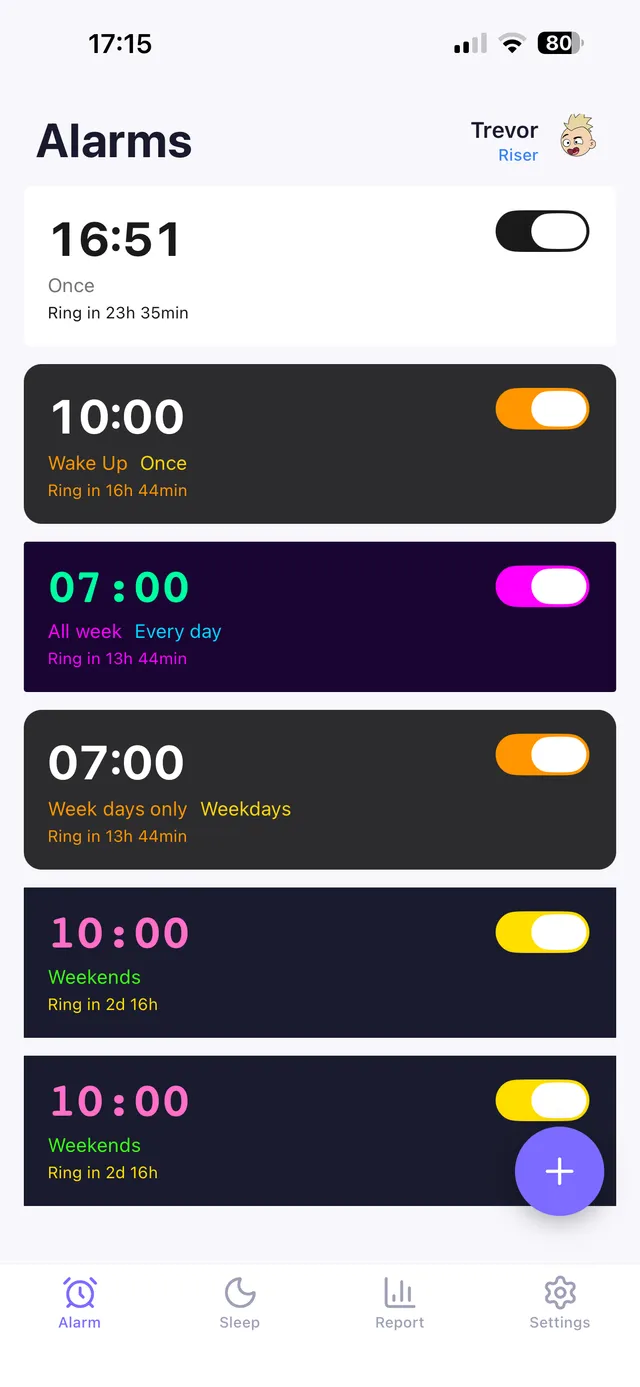
Even a perfectly timed cycle doesn't guarantee you'll get out of bed — that's a separate problem. OwlRoutine's mission alarm handles the "I know I should get up but I keep hitting snooze" part, requiring a quick task like solving a math problem or snapping a photo before the alarm will stop, so a good night's cycles actually translate into an on-time morning.
Frequently asked questions
How many sleep cycles should I get per night?
Most adults should aim for 5 to 6 sleep cycles per night, which works out to roughly 7.5 to 9 hours of sleep, since each cycle averages about 90 minutes.
How long is one sleep cycle?
A sleep cycle is typically around 90 minutes on average, though individual cycles can range from about 70 to 120 minutes and vary across the night.
Is it better to sleep for a set number of hours or a set number of cycles?
Cycles matter more than raw hours. Waking up at the end of a cycle, during lighter sleep, feels far better than being woken mid-cycle during deep sleep, even if the total hours are similar.
Is 4 sleep cycles enough?
Four cycles is about 6 hours, which is on the low end for most adults and often leaves you under-rested over time, though it can work occasionally in a pinch.
How do I know how many cycles I personally need?
Track how you feel across a week or two at different total sleep times and notice when you consistently wake up clear-headed without an alarm — that points to your personal cycle count.
Wake up for real. Wind down for good.
OwlRoutine is a sleep-cycle alarm that makes mornings actually stick — with a guided wind-down, dismiss missions, sleep scores and rewards. Available on iPhone and Android.