Wearable vs Phone: Which Way of Tracking Sleep Is Actually Right for You?
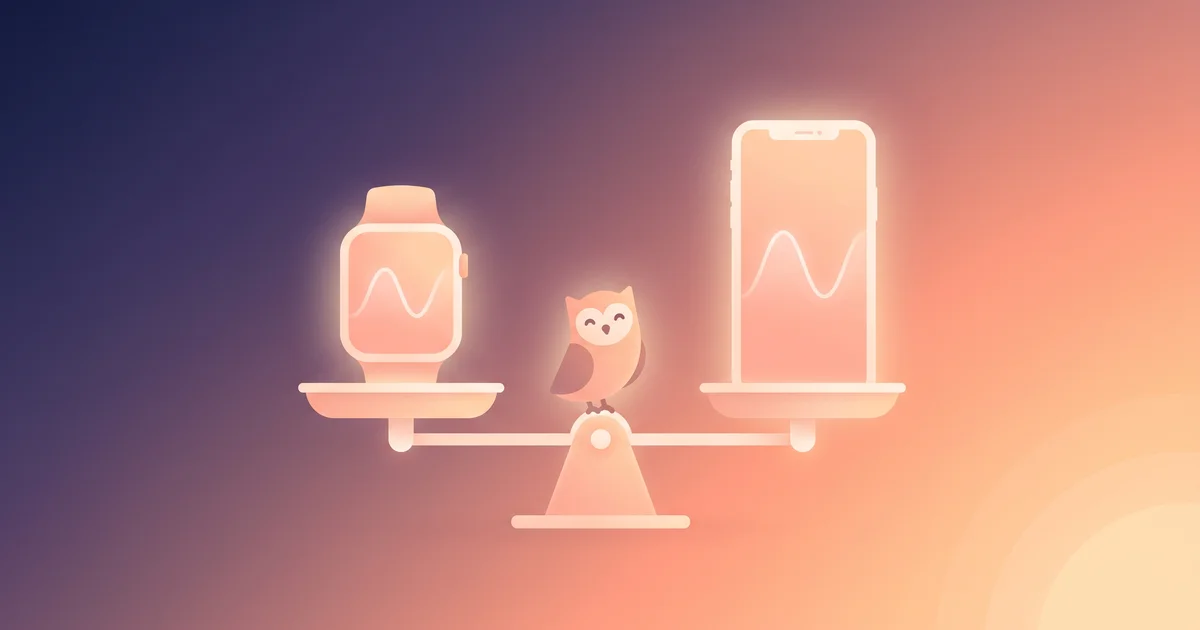
Not everyone wants to sleep with something strapped to their wrist or finger. The good news: you don't have to. Phone-based sleep tracking apps have gotten genuinely capable, using your phone's microphone and accelerometer from the nightstand instead of a device on your body. So which approach actually makes more sense — a wearable or your phone?
The short answer
Wearables (rings, watches, bands) generally give more precise movement and heart-rate data because they're in direct contact with your body, which can translate to somewhat better sleep-stage estimates. Phone-based apps are free or cheap, require no extra device, and work by listening for sound and sensing nearby motion — good for tracking total sleep time and disturbances like snoring or coughing, but less precise about fine-grained movement and unable to read your heart rate at all. Neither is a medical-grade solution; see do sleep trackers actually work for that broader caveat.
How each approach actually works
Wearables (rings and watches) sit against your skin and combine:
- Direct heart rate and HRV readings
- Accelerometer data from actual body movement
- Sometimes skin temperature and blood oxygen
Phone apps sitting on your nightstand typically use:
- The phone's microphone, to detect snoring, coughing, talking or environmental noise
- The phone's accelerometer, to detect vibrations from your movement transmitted through the mattress or bed frame
- Sometimes a manual sleep/wake button you tap yourself
The core difference is contact: a wearable feels your body directly; a phone infers what's happening a few feet away.
Accuracy tradeoffs
| Factor | Wearable | Phone app |
|---|---|---|
| Heart rate data | Yes | No |
| Movement detection | Direct, precise | Indirect, via mattress vibration |
| Snoring/sound detection | Rare | Yes, a genuine strength |
| Sleep stage estimates | More inputs to work with | Rougher, motion-only |
| Affected by a partner/pet in bed | Less (device is on you specifically) | More (any nearby movement can register) |
Phone apps genuinely shine at one thing wearables mostly don't: audio-based detection of snoring, coughing and sleep talking, since a microphone can pick up sounds a wrist sensor never will. For a deeper look at wearable-specific stage estimation, see how fitness trackers estimate sleep stages.
Convenience and cost
Phone apps win decisively here. Most people already own a phone, many sleep-tracking apps are free or low-cost, and there's no charging routine to manage beyond your normal phone charging. Wearables require an upfront purchase (sometimes a significant one) and, in many cases, an ongoing subscription for full insights.
OwlRoutine helps you wind down at night and actually get up in the morning — with a guided wind-down, dismiss missions, and sleep scores. Available on iPhone and Android.


Comfort: the real deciding factor for many people
Some people simply don't want anything on their body at night — a watch feels bulky, a ring feels foreign, a chest strap is a non-starter. For this group, a phone on the nightstand is the obvious answer regardless of any accuracy tradeoff, because the most accurate tracker in the world is useless if you take it off in frustration at 2am. If this describes you, also look at sleep trackers without any wearable at all, including under-mattress sensors that don't even require a phone nearby.
Downsides of phone-based tracking
- Needs to stay near the bed all night, which some people avoid for reasons of screen habits or radiation concerns (largely unfounded, but a common personal preference).
- No heart-rate data, so stage estimates are generally rougher than wearables.
- Sensitive to environment — a partner, pet, or even a fan vibrating the nightstand can skew movement readings.
- Battery drain — running sensors and sometimes recording audio all night uses phone battery, so many people need to keep it plugged in.
Downsides of wearables
- Cost, both upfront and often ongoing via subscription.
- Comfort — some people never get used to wearing something to bed.
- Charging schedule — a device that dies mid-night stops recording.
- One more thing to maintain, track, size correctly and eventually replace.
A practical way to decide
- If you want snoring/sound insights specifically — phone app, since microphones are a wearable blind spot.
- If you want the most detailed heart-rate-based sleep-stage data — a wearable, ring or watch.
- If cost is the deciding factor — phone app, usually free or cheap.
- If you already hate wearing things to bed — phone app, no contest.
- If you're an athlete who wants sleep data alongside training recovery metrics — a wearable makes more sense, since it integrates with fitness tracking too.
The bottom line
Wearables generally offer richer data because they're in direct contact with your body, but phone apps are free, convenient, comfortable and genuinely good at catching sounds like snoring that wearables miss entirely. Neither is medically precise, and the "best" choice really comes down to whether you're willing to wear something to bed and how much you value granular heart-rate data versus simplicity.
OwlRoutine takes a phone-first approach on purpose: no wearable to buy, size or charge, just a guided wind-down routine before bed and a mission-based alarm in the morning — the two moments that matter most, whether or not you're also tracking every heartbeat in between.
Frequently asked questions
Is a wearable more accurate than a phone app for sleep tracking?
Wearables generally provide more precise movement and heart-rate data since they're in direct contact with your body, but phone apps are better at detecting sounds like snoring and require no extra device.
Can my phone track my sleep without a wearable?
Yes. Phone-based sleep apps use the microphone and accelerometer to estimate sleep and detect sounds like snoring, though they can't measure heart rate.
Does a partner or pet affect phone-based sleep tracking?
Yes, more than a wearable would — a phone on the nightstand can pick up movement or sound from anyone or anything nearby, since it isn't measuring your body directly.
Which is cheaper, a wearable or a phone sleep app?
Phone apps are generally cheaper or free, since most people already own a phone, whereas wearables involve an upfront device cost and sometimes an ongoing subscription.
Wake up for real. Wind down for good.
OwlRoutine is a sleep-cycle alarm that makes mornings actually stick — with a guided wind-down, dismiss missions, sleep scores and rewards. Available on iPhone and Android.