Do Sleep Trackers Work? What Rings, Watches and Apps Can (and Can't) Tell You
Smart rings, smartwatches, bedside sensors and phone apps all promise to tell you how well you slept — often with a single score every morning. Millions of people now check their sleep data before they check their messages. But do sleep trackers work? And is checking your sleep score every day actually helping?
The short answer
Consumer sleep trackers are reasonably good at estimating total sleep time and your schedule (when you fell asleep and woke up), especially when used consistently. They are much less accurate at sleep stages (light, deep, REM) than a clinical sleep study. They're useful for spotting trends and habits — not for diagnosing sleep disorders or judging a single night. And for some people, obsessing over scores (orthosomnia) can make sleep worse.
How sleep trackers work
Most consumer trackers use some combination of:
- Movement (accelerometers) — less movement suggests sleep.
- Heart rate and heart rate variability — patterns change across sleep stages.
- Blood oxygen, skin temperature and breathing rate on some devices.
- Sound or radar on some bedside devices.
They feed this into algorithms trained against polysomnography (PSG) — the lab gold standard that measures brain waves, eye movements, muscle activity and breathing. Trackers don't measure brain activity, so they infer sleep stages indirectly.
How accurate are they?
| Measure | Typical consumer tracker accuracy |
|---|---|
| Bedtime and wake time | Good |
| Total sleep time | Fairly good, often slightly off |
| Time awake during the night | Moderate; often underestimated |
| Sleep stages (light/deep/REM) | Limited; useful as rough estimates |
| Sleep disorders (e.g. apnea) | Not a diagnosis; some devices flag possible issues |
Validation studies generally find that modern wearables detect sleep versus wake reasonably well, but agree with PSG much less closely for individual sleep stages. Accuracy also varies between devices and between people.
What sleep trackers are genuinely good for
- Seeing your real schedule. Many people think they sleep 7.5 hours and actually average 6.
- Spotting patterns — later bedtimes on weekends, shorter sleep after alcohol, better nights after exercise.
- Motivation for habits like a consistent bedtime.
- Flagging possible issues worth discussing with a doctor, like very frequent waking.
OwlRoutine helps you wind down at night and actually get up in the morning — with a guided wind-down, dismiss missions, and sleep scores. Available on iPhone and Android.


The problem: orthosomnia
In 2017, researchers described orthosomnia: a preoccupation with achieving perfect sleep data. People became anxious about their tracker scores, changed their behaviour to chase better numbers, and sometimes slept worse. A low score on the morning display can make you feel worse than you actually are.
This has become a bigger concern with the sleepmaxxing trend, where perfect scores are shared online.
Signs your tracker is hurting more than helping:
- You feel anxious before bed about your score.
- A bad score ruins your mood even when you feel fine.
- You spend more time in bed trying to "improve" numbers.
- You check data during the night.
How to use sleep data wisely
- Look at weekly trends, not nightly scores.
- Trust how you feel. If you feel rested and alert, a low "deep sleep" number isn't a reason to worry.
- Focus on behaviours you control: wake time, bedtime, caffeine, alcohol, screens. Sleep hygiene checklist.
- Don't check data in the night. Put the phone away. What phones do to sleep.
- Take breaks if you notice anxiety. Some people sleep better when they stop tracking entirely for a while.
- See a doctor for real concerns — snoring, gasping, persistent insomnia or daytime sleepiness need proper assessment, not a ring.
Which type of tracker should you choose?
| Type | Strengths | Limitations |
|---|---|---|
| Smartwatch | Convenient, multi-purpose, heart rate data | Can be uncomfortable in bed; needs charging |
| Smart ring | Comfortable, long battery life | Small sensor, still estimates stages |
| Bedside / under-mattress sensor | Nothing to wear | Can be confused by partners or pets |
| Phone app on the mattress | Free or cheap | Movement-only; least accurate |
If you mainly want to know your real bedtime and wake time, almost any option works. If a device makes you think about sleep more than you'd like, the cheapest option is often no device at all.
Tracking sleep vs tracking habits
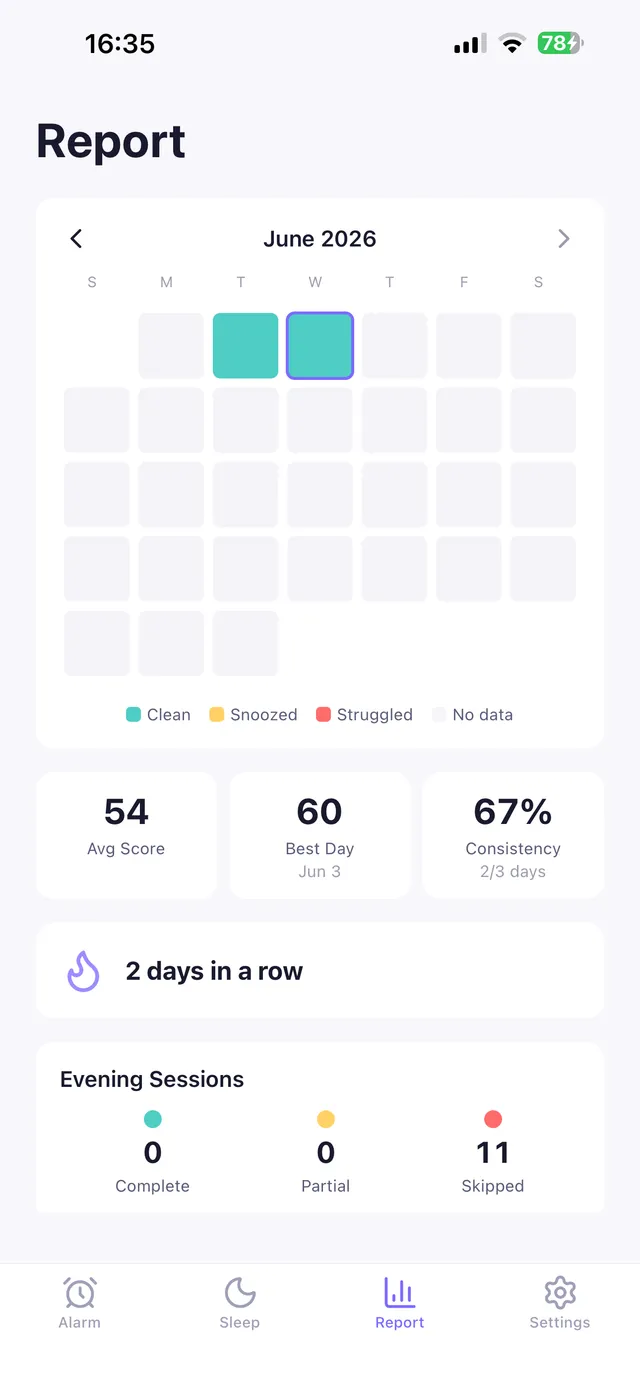
There's a middle ground: instead of trying to measure sleep stages, track the habits that drive good sleep — did you wind down, did you put the phone away, did you get up at your alarm? These are things you control, and they're measured accurately by definition.
The bottom line
Sleep trackers are decent at telling you when and roughly how long you slept, and much weaker at sleep stages. Use them for trends and motivation, not nightly verdicts. If your score is keeping you up at night, it's doing more harm than good.
OwlRoutine takes the habits-first approach. It doesn't claim to measure your brain waves; it tracks the things that drive good sleep — whether you completed your wind-down (with face-down detection), whether you got up at your alarm — and shows them as a cycle score, streaks, weekly charts and a monthly heatmap.
This article is general information, not medical advice.
Frequently asked questions
Are sleep trackers accurate?
They're reasonably accurate for bedtime, wake time and total sleep, but much less accurate for sleep stages compared with a clinical sleep study.
Can a sleep tracker diagnose sleep apnea?
No. Some devices may flag possible breathing issues, but diagnosis requires a proper assessment by a doctor or sleep clinic.
What is orthosomnia?
Orthosomnia is a preoccupation with achieving perfect sleep data from trackers, which can cause anxiety and actually make sleep worse.
Should I stop using my sleep tracker?
If checking scores makes you anxious or you feel worse after seeing them, taking a break can help. Otherwise, focus on weekly trends and how you feel rather than nightly scores.
Wake up for real. Wind down for good.
OwlRoutine is a sleep-cycle alarm that makes mornings actually stick — with a guided wind-down, dismiss missions, sleep scores and rewards. Available on iPhone and Android.