What Is a Sleep Score, and How Much Should You Trust It?
You wake up, check your phone, and a number tells you how you slept before you've even had a chance to decide for yourself. Sleep scores — used by Oura, Fitbit, Garmin, Apple, Samsung and countless sleep apps — turn a night's sleep into a single figure out of 100. It's satisfying. It's also, in most cases, an estimate built from a handful of proxy measurements, not a direct read of your brain.
The short answer
A sleep score is a composite number, usually 0–100, generated from metrics like total sleep time, time spent in different sleep stages, how long it took you to fall asleep, and how many times you woke up or moved. Different devices weigh these factors differently and use different algorithms, which is why the same night's sleep can produce different scores on different devices. Treat the score as a rough trend indicator, not a precise grade.
What actually goes into a sleep score
Most sleep scores are built from some combination of:
| Input | What it tries to capture |
|---|---|
| Total sleep time | Did you get enough hours overall |
| Sleep efficiency | Time actually asleep vs time spent in bed |
| Time to fall asleep (sleep latency) | Was your wind-down effective |
| Sleep stage estimates (light, deep, REM) | Rough balance across stages |
| Restlessness / wake events | How fragmented the night was |
| Consistency with your usual schedule | Regularity of bed and wake times |
| Resting heart rate / HRV trends | Physiological signs of recovery |
Each brand picks its own formula and weighting, which is exactly why there's no universal "good" score — a 78 on one app and a 78 on another aren't necessarily describing the same night.
Why scores differ between devices
None of these consumer devices measure brain waves (the gold standard, used in clinical polysomnography). Instead they infer sleep stages from movement and heart-rate patterns, an approach broadly called actigraphy plus heart-rate-based inference. See how fitness trackers estimate sleep stages for how that actually works under the hood.
Because each company:
- Uses slightly different sensors (wrist vs finger vs under-mattress),
- Weighs inputs differently in its scoring formula, and
- Tunes its algorithm against its own reference data,
...the same night of real sleep can produce meaningfully different scores across an Oura Ring, a Fitbit, a Garmin watch and an Apple Watch. This isn't a sign anything is "wrong" — it's just different math applied to imperfect proxy signals. For a broader look at wearable accuracy limits, see do sleep trackers actually work.
Is a low score always bad?
Not necessarily. A few things can drag a score down without meaning you slept poorly:
- A late-night bathroom trip that counted as a long "wake" event.
- A restless partner or pet moving the bed and registering as your movement.
- A device slipping and losing skin contact for part of the night.
- Naturally lighter sleep during certain nights (this varies for everyone and isn't automatically unhealthy).
Equally, a high score isn't a guarantee you'll feel great — how you feel in the morning is still the most honest single data point you have.
OwlRoutine helps you wind down at night and actually get up in the morning — with a guided wind-down, dismiss missions, and sleep scores. Available on iPhone and Android.


How much should you actually trust it?
Sleep scores are most useful as trend lines, not daily report cards. A single night's number swinging up or down by a few points is mostly noise. What's meaningful is the pattern over weeks: is your average trending up or down, are certain habits (late caffeine, inconsistent bedtimes, alcohol) consistently correlating with lower scores?
Obsessing over the nightly number instead of the trend — and adjusting your whole day's mood around it — is the exact trap known as orthosomnia, where anxiety about sleep tracking itself becomes a sleep problem. If you notice this happening, it might be worth taking a tracking break entirely.
What a good score actually looks like
There's no single universal threshold, but generally:
- Scores in the high 80s–90s tend to reflect solid, consistent, uninterrupted sleep on most platforms.
- Scores in the 60s–70s often reflect a night that was adequate but fragmented or short.
- Scores below that usually correlate with genuinely short or disrupted sleep — worth noticing if it's a pattern, not a one-off.
These ranges are rough and vary by brand — don't compare your score directly to a friend's if you use different devices.
Using your score productively
Instead of reacting to the number itself, look at what's underneath it:
- Total sleep time — are you consistently under seven hours?
- Time to fall asleep — is it creeping up (a sign your wind-down needs work)?
- Consistency — are your bed and wake times swinging by hours night to night? Sleep consistency matters more than almost any single-night metric.
Changing these underlying habits is what actually moves your score over time — see how to improve your sleep score for specifics.
The bottom line
A sleep score is a useful shorthand built from imperfect proxy data — movement, heart rate, timing — run through a formula that's different on every platform. It's genuinely helpful for spotting trends over weeks, genuinely unhelpful as a source of nightly anxiety, and never a substitute for how you actually feel when you wake up.
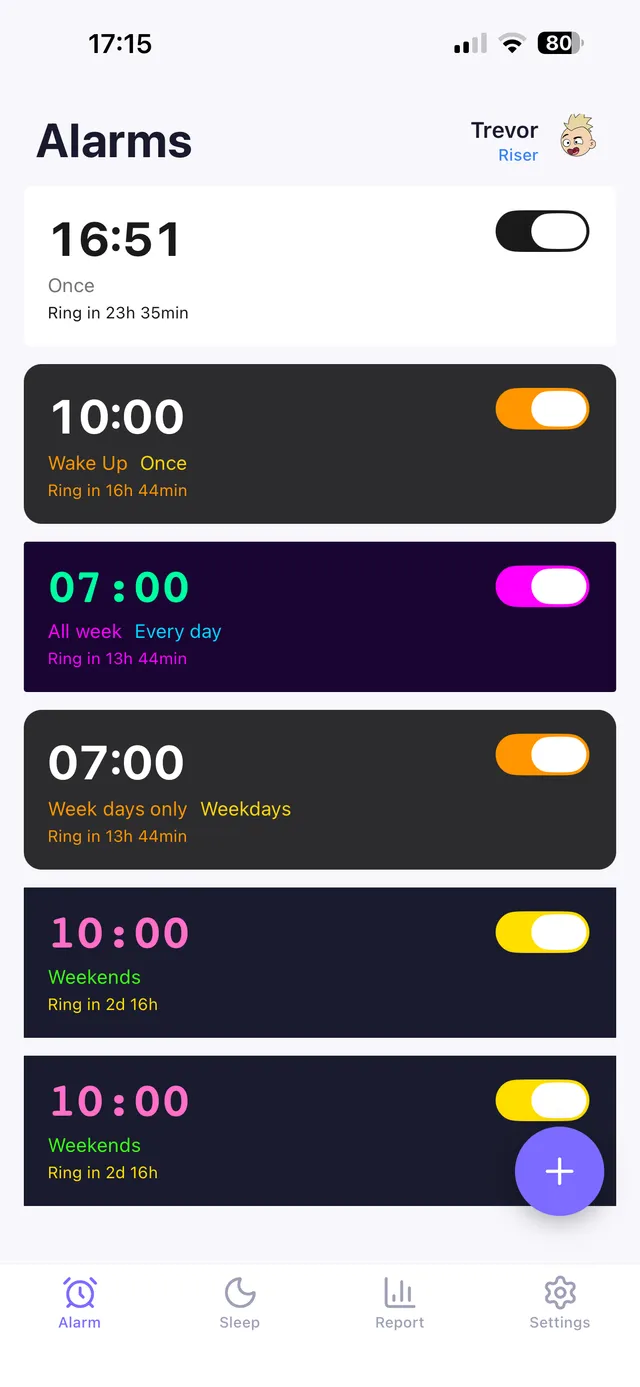
OwlRoutine doesn't chase a sleep score — instead it focuses on the two things that reliably move real sleep quality: a guided wind-down that gets your mind ready for bed, and a mission-based alarm that ends the morning with a real wake-up instead of a groggy snooze spiral, whatever number your tracker showed you.
Frequently asked questions
What is a good sleep score?
There's no universal number, but on most platforms scores in the high 80s to 90s generally reflect consistent, uninterrupted sleep, while scores below 60 often reflect shorter or more fragmented nights.
Why do I get different sleep scores on different apps?
Each platform uses its own sensors, algorithm and weighting of factors like sleep duration, stages and restlessness, so identical sleep can produce different scores on different devices.
How is a sleep score calculated?
Most sleep scores combine total sleep time, sleep efficiency, time to fall asleep, estimated sleep stages, restlessness and sometimes heart-rate trends into a single weighted number.
Should I worry about a low sleep score?
A single low score is often noise from things like a bathroom trip or a device losing contact. Focus on the trend over several weeks rather than reacting to one night's number.
Wake up for real. Wind down for good.
OwlRoutine is a sleep-cycle alarm that makes mornings actually stick — with a guided wind-down, dismiss missions, sleep scores and rewards. Available on iPhone and Android.