How to Wake Up a Heavy Sleeper (Including Yourself): 11 Methods That Actually Work
If you've slept straight through three alarms, a ringing phone and a roommate banging on the door, you already know that "just set a louder alarm" doesn't work. Learning how to wake up a heavy sleeper — whether that's you or someone you live with — is less about volume and more about timing, friction and the night before. Heavy sleepers aren't broken. Most of them are waking from deep sleep, with an alarm they can silence without ever becoming conscious, after a night that set them up to fail.
This guide ranks the methods that actually work, explains why the obvious ones don't, and shows how to stack them so mornings stop being a coin flip.
The short answer
The most reliable way to wake up a heavy sleeper is to combine three things: an alarm that can't be dismissed without real cognitive effort (a "mission"), a consistent sleep schedule so the alarm lands in lighter sleep, and a bright, active first five minutes. Louder alarms help less than you'd think — the problem is rarely that the sound isn't heard; it's that it gets switched off on autopilot.
Why some people are "heavy sleepers"
There's no single medical definition of a heavy sleeper, but a few factors reliably make people harder to wake:
- Being in deep (N3) sleep when the alarm rings. Deep sleep has the highest arousal threshold of any stage. An alarm that hits mid-cycle feels like being dragged out of concrete. How sleep cycles work explains why timing matters so much.
- Sleep debt. The shorter your recent nights, the more your brain prioritises deep sleep and the harder it fights waking.
- Irregular schedules. If your wake time drifts by two hours between weekdays and weekends, your body never learns when to start preparing to wake.
- Alcohol, late meals and late screens, which fragment the first half of the night and push restorative sleep later.
- Undiagnosed sleep disorders. Sleep apnea, for example, can leave people exhausted and hard to rouse despite long nights. If you snore loudly, wake gasping, or feel wrecked after 8+ hours, talk to a doctor — no alarm fixes that.
The 11 methods, ranked
| # | Method | Why it works | Effort |
|---|---|---|---|
| 1 | Mission alarm (math, photo, typing) | Forces your brain fully online before the sound stops | Low |
| 2 | Same wake time every day | Your body starts waking itself before the alarm | Medium |
| 3 | Better night before (wind-down) | Less sleep debt = lighter, easier waking | Medium |
| 4 | Alarm across the room | You must stand up to silence it | Low |
| 5 | Light immediately | Suppresses melatonin, raises alertness | Low |
| 6 | Turn off snooze | Removes the half-asleep negotiation | Low |
| 7 | Melodic alarm sound | Linked to less morning grogginess than harsh beeps | Low |
| 8 | Backup alarm, different device | Protects against silent-mode and dead-battery failures | Low |
| 9 | Vibrating/bed-shaker alarm | Adds touch to sound for very deep sleepers | Medium |
| 10 | Water by the bed | A small, immediate physical task | Low |
| 11 | Accountability (a person or a streak) | Gives you a reason bigger than "five more minutes" | Medium |
1. Use an alarm that makes you think
The reason heavy sleepers sleep through alarms is usually not that they never hear them. It's that they dismiss them without waking up — a motor habit that happens below conscious awareness. You tap "stop," roll over, and genuinely have no memory of it.
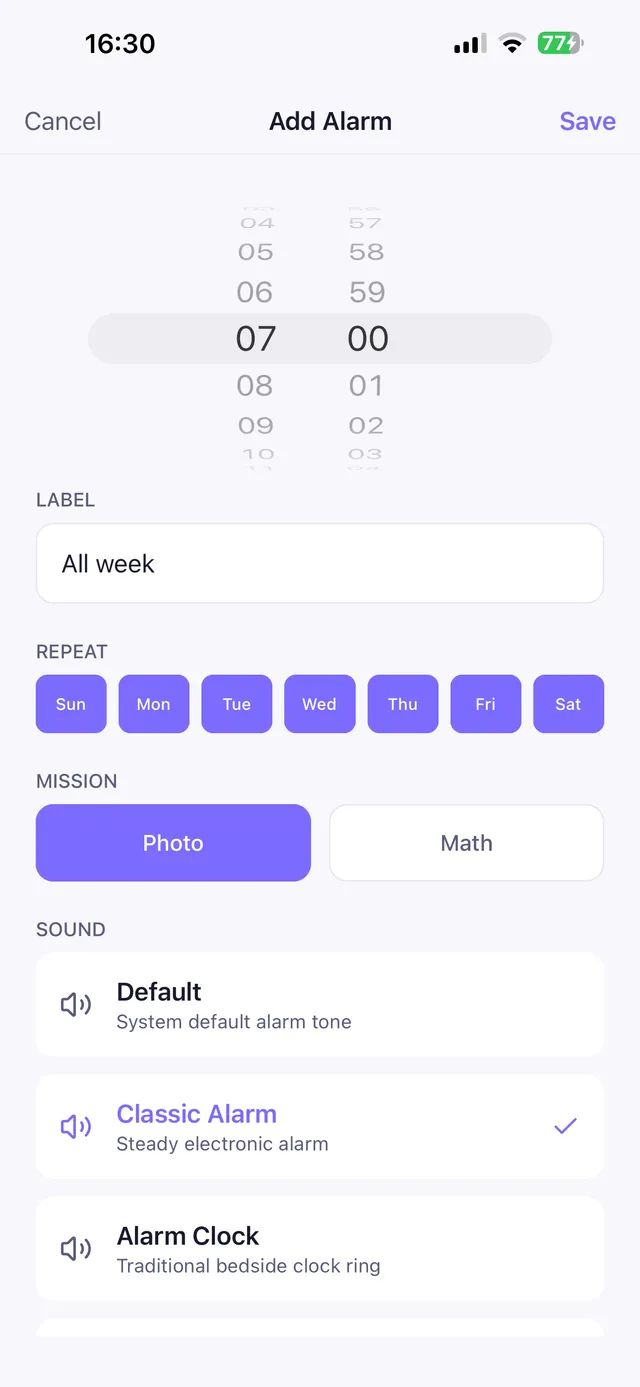
A mission alarm breaks that loop. Solving a short math problem, typing a phrase or taking a photo of a specific spot in your home requires working memory and coordination that a half-asleep brain can't fake. By the time you've finished, you're awake enough to stay awake. We compare the main options in OwlRoutine vs Alarmy vs Wayk.
2. Fix the wake time before the alarm
A body that wakes at 7:00 every day starts raising core temperature and cortisol before 7:00 — it anticipates the alarm. A body that wakes at 6:30 on Monday and 11:00 on Sunday never gets that head start. Sleep consistency matters more than sleep length for exactly this reason. Pick one wake time and keep it seven days a week, including weekends, for two weeks.
3. Win the night, not just the morning
Most "morning problems" start at 11pm. If you're scrolling until 1am, no alarm on earth makes 7am feel fine. A 20–30 minute wind-down routine — dim lights, phone away, something calm — gets you asleep earlier, which means fewer mornings where the alarm lands in the deepest sleep of the night.
4. Put the alarm out of reach
Classic, but still effective: if the phone is across the room, you have to stand up to silence it. The weakness is obvious — plenty of heavy sleepers walk over, turn it off and walk back to bed. Pair it with a mission so standing up isn't the end of the task.
5. Flood the room with light
Light is the strongest signal your circadian clock receives. Open the curtains, switch on the main light or step outside for a few minutes. A dim room keeps you in a melatonin fog; a bright one tells your brain the day has started.
6. Delete the snooze habit
Snoozing splits the last stretch of sleep into fragments that aren't restorative, and it trains you to treat the first alarm as a suggestion. Here's why snoozing makes you more tired. If you can't go cold turkey, allow one snooze with a short duration — and track how often you use it.
OwlRoutine helps you wind down at night and actually get up in the morning — with a guided wind-down, dismiss missions, and sleep scores. Available on iPhone and Android.
7. Choose a melodic alarm tone
A 2020 study from RMIT University in Australia found that people who woke to melodic alarm sounds reported less morning grogginess than those who woke to harsh, beeping tones. It's not a magic fix, but if your current tone is a jarring buzzer that you've learned to tune out, switching to something with a clear melody is an easy experiment.
8. Have a backup that fails differently
Many "I slept through my alarm" mornings are actually "my alarm never rang" mornings — a phone left on silent, a Focus mode that swallowed the notification, or a battery that died overnight. A second alarm on a different device covers you. On iPhone, apps built on Apple's AlarmKit (iOS 26 and later) can ring through Silent mode and Focus, just like the built-in Clock app.
9. Add vibration for the deepest sleepers
For people who genuinely don't register sound — including many people with hearing loss — bed-shaker or wearable vibrating alarms add a tactile signal. They're worth it if methods 1–8 haven't moved the needle.
10. Give yourself a tiny first task
Drink a full glass of water, make the bed, wash your face. A concrete physical task in the first two minutes gives momentum and makes crawling back under the covers less automatic.
11. Make it cost something to fail
Heavy sleepers often have plenty of motivation at 10pm and none at 7am. A visible streak, a sleep score you care about, or a friend who expects a text by 7:15 carries your 10pm intentions into the morning.
How to wake up someone else who's a heavy sleeper
If it's your partner, kid or roommate:
- Start with light, then voice — open the curtains and say their name before touching them.
- Avoid shocks like cold water or shouting. Startle-waking spikes heart rate and tends to produce a grumpy, confused person rather than an awake one.
- Ask them to set up their own system (mission alarm, fixed wake time). Being someone's alarm clock every morning is exhausting and doesn't build the habit.
The bottom line
Waking up as a heavy sleeper isn't a willpower contest. Fix your wake time, protect the night before, and use an alarm that requires your brain — not just your thumb — to switch off. Add light and a small first task, and most "impossible" mornings become ordinary ones within a couple of weeks.
That's the logic behind OwlRoutine. Its alarms can require a math, word, typing or bed-photo mission before they stop, and the mission is easier after a night you actually wound down properly. On iOS 26 and later it uses Apple's AlarmKit so alarms can ring through Silent mode, and a morning heatmap shows whether your wake-ups are genuinely getting easier.
This article is general information, not medical advice. If you regularly feel exhausted despite long sleep, speak to a doctor about possible sleep disorders.
Frequently asked questions
Why can't I wake up to my alarm?
Usually because the alarm lands in deep sleep and you dismiss it on autopilot without becoming fully conscious. Sleep debt, irregular wake times and alarms that can be silenced with one tap all make it worse.
What is the best alarm for a heavy sleeper?
An alarm that requires a mission to dismiss — solving math, typing a phrase or photographing a specific spot — combined with a consistent wake time. For very deep sleepers or people with hearing loss, a vibrating bed-shaker alarm can help too.
Is being a heavy sleeper a medical problem?
Not usually. But if you sleep 8+ hours and still feel exhausted, snore loudly or wake gasping, ask a doctor about sleep apnea or other sleep disorders.
How do I wake up a heavy sleeper without startling them?
Start with light — open curtains or switch on a lamp — then use their name. Avoid shouting or cold water, which cause a stress response rather than a clear-headed wake-up.
Wake up for real. Wind down for good.
OwlRoutine is a sleep-cycle alarm that makes mornings actually stick — with a guided wind-down, dismiss missions, sleep scores and rewards. Available on iPhone and Android.