Oura Ring vs Fitbit for Sleep Tracking: Which One Actually Helps You Sleep Better?

If you've narrowed your sleep-tracking search down to two names, they're probably these: the Oura Ring and Fitbit. Both are popular, both promise detailed sleep insights, and both come from companies that talk a lot about "sleep scores." But they're built differently, worn differently, and better at different things. Here's how they actually compare for sleep — not fitness, not steps, just sleep.
The short answer
For sleep tracking specifically, the Oura Ring tends to be more comfortable to wear overnight (many people forget it's there) and puts sleep at the center of its app experience, while Fitbit is a strong all-rounder that bundles sleep with fitness tracking at a lower price point and often a longer battery life on some models. Neither reads brainwaves, so treat both as good estimators of trends, not lab-grade instruments — see do sleep trackers actually work for the bigger picture on accuracy.
How each one tracks sleep
Both devices rely on similar core inputs, just packaged differently:
| Signal | Oura Ring | Fitbit |
|---|---|---|
| Heart rate / HRV | Yes, via finger arteries (strong signal location) | Yes, via wrist (more motion-sensitive) |
| Movement (accelerometer) | Yes | Yes |
| Skin temperature | Yes, nightly trend | On some models |
| Blood oxygen (SpO2) | Yes, on newer generations | On some models |
| Form factor | Ring | Wrist band or watch |
Neither device measures brain activity directly. Both use a combination of movement and heart-rate patterns — a technique broadly called actigraphy plus heart-rate-based inference — to guess whether you're awake, in light sleep, deep sleep or REM. For the mechanics of how that guessing works, see how fitness trackers estimate sleep stages.
Comfort and wearability
This is where the two devices diverge most for sleep specifically.
- Oura Ring: Small, lightweight, no screen glow, no band to catch on bedding. Most users report barely noticing it at night. The tradeoff is sizing — rings need a proper fit, and some people find any ring uncomfortable on certain fingers.
- Fitbit: Comfortable for most people, but a wrist band or watch body is bulkier than a ring. Side sleepers who tuck a hand under a pillow sometimes notice it more than ring wearers do.
If wearing anything to bed bothers you regardless of form factor, it's worth reading about phone-based or wearable-free tracking before buying either.
Battery life
Oura Rings are built to go several days between charges, and many people charge them during a shower or while getting dressed rather than overnight — which matters because a dead device can't track sleep. Fitbit's battery life varies a lot by model: some trackers last close to a week, while GPS-heavy smartwatches in the Fitbit lineup may need nightly or near-nightly charging. If you tend to forget to charge things, check the specific model's battery life before assuming.
OwlRoutine helps you wind down at night and actually get up in the morning — with a guided wind-down, dismiss missions, and sleep scores. Available on iPhone and Android.


App experience and what you actually see
Oura's app is built around sleep and readiness as the main event — you open it and your sleep score, temperature trend and readiness score are front and center, with fitness features as a secondary layer. Fitbit's app treats sleep as one tab among several (steps, exercise, heart rate, stress), which some people prefer because everything lives in one place, and others find distracting if sleep is their main goal.
Both apps assign a nightly sleep score — see what a sleep score actually measures for why two devices can disagree on the same night's sleep even when you slept exactly the same.
Price and subscription
Oura requires a monthly membership to unlock full sleep insights beyond the basics — factor that ongoing cost in alongside the ring's purchase price. Fitbit also has a premium subscription tier for deeper sleep insights, but many of its core sleep metrics (time asleep, basic sleep stages) are available without a subscription on most models. If ongoing cost matters more than device elegance, compare the subscription terms carefully before buying either.
Which one fits you better
| You are... | Consider |
|---|---|
| Someone who hates wearing a watch to bed | Oura Ring |
| Someone who also wants detailed workout/GPS tracking | Fitbit (or a Fitbit-brand smartwatch) |
| On a tighter budget | Fitbit, generally |
| Prioritizing a clean, sleep-first app | Oura |
| New to sleep tracking and just want the basics | Either — both give reliable trend data |
What neither one fixes
A sleep score, however pretty the graph, doesn't get you out of bed in the morning or help you wind down at night. Both devices are measurement tools, not behavior-change tools — they tell you that you slept badly, not what to do about it, and neither will physically stop you from hitting snooze for the tenth time.
The bottom line
Oura and Fitbit both do a competent job of estimating sleep duration and rough sleep stages using heart rate and movement, and picking between them mostly comes down to comfort, budget and whether you want a sleep-first or fitness-first app. Neither is a lab sleep study, and neither will change your habits by itself — for that, see how to actually improve your sleep score.
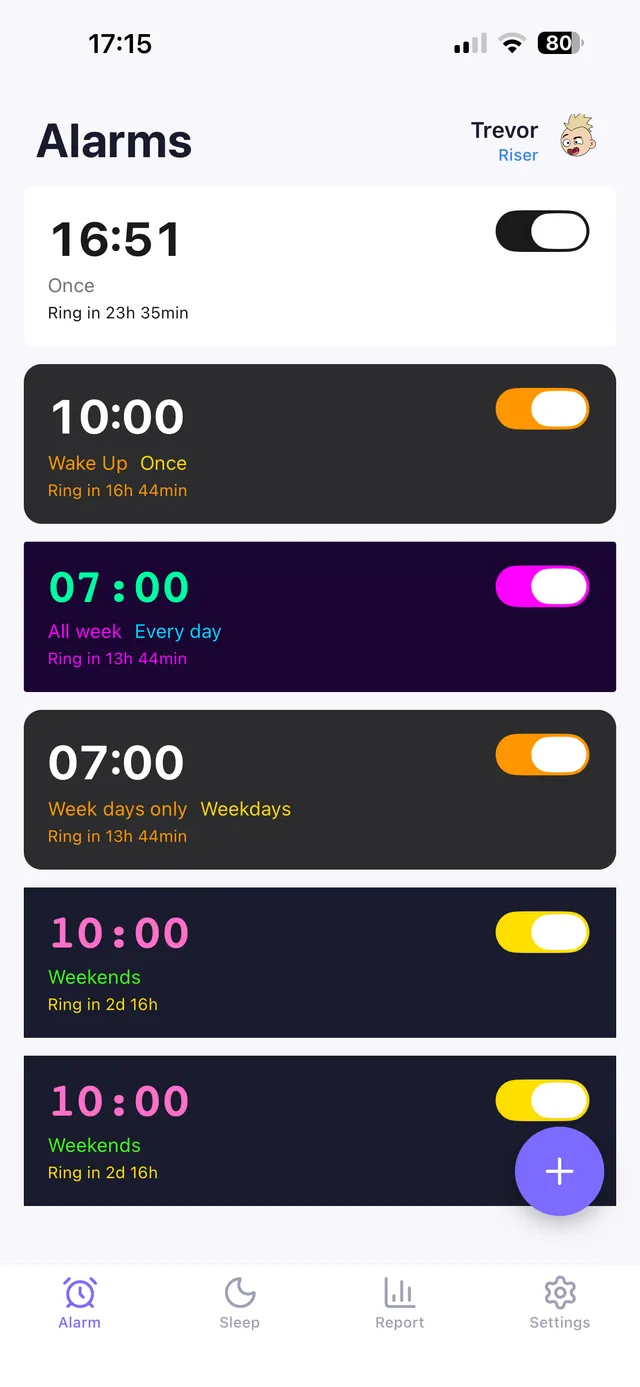
Whatever device (or none) you use to measure your sleep, OwlRoutine works alongside it rather than competing with it: no wearable required, just a guided wind-down before bed and a mission-based alarm that makes sure good data on your ring or watch actually translates into you getting up in the morning.
Frequently asked questions
Is Oura or Fitbit more accurate for sleep tracking?
Both use similar underlying methods (heart rate and movement), and neither reads brainwaves directly, so accuracy is broadly comparable for total sleep time, with more variability in exact sleep-stage boundaries. Comfort and consistency of wear often matter more than small accuracy differences.
Do I need a subscription for Oura or Fitbit sleep tracking?
Oura requires an ongoing membership for full sleep insights. Fitbit offers many core sleep metrics without a subscription on most models, with deeper insights behind its premium tier.
Which is more comfortable to wear at night, a ring or a wristband?
Most users find a ring less noticeable overnight than a wristband or watch, though this varies by sleep position and personal preference.
Can I use both a ring and a watch at the same time?
Yes, though it's rarely necessary for sleep alone — pick one as your primary sleep tracker to avoid conflicting data and just compare trends over time rather than single nights.
Wake up for real. Wind down for good.
OwlRoutine is a sleep-cycle alarm that makes mornings actually stick — with a guided wind-down, dismiss missions, sleep scores and rewards. Available on iPhone and Android.